REEID EDITORIAL
How multilingual WordPress interacts with SEO plugins
In multilingual WordPress sites, the main technical question is not whether SEO plugins can help, but which system owns each search signal. Titles, descriptions, canonicals, schema, XML sitemaps, robots directives, and language relationships all need a clear source of truth so translated pages do not compete with each other or send conflicting signals to search engines.
Key takeaway
Treat multilingual architecture and SEO plugins as separate layers: the multilingual layer should define language versions and relationships, while the SEO layer should emit page-level metadata without overriding those relationships or duplicating signals.
Where multilingual architecture ends and SEO plugin ownership begins
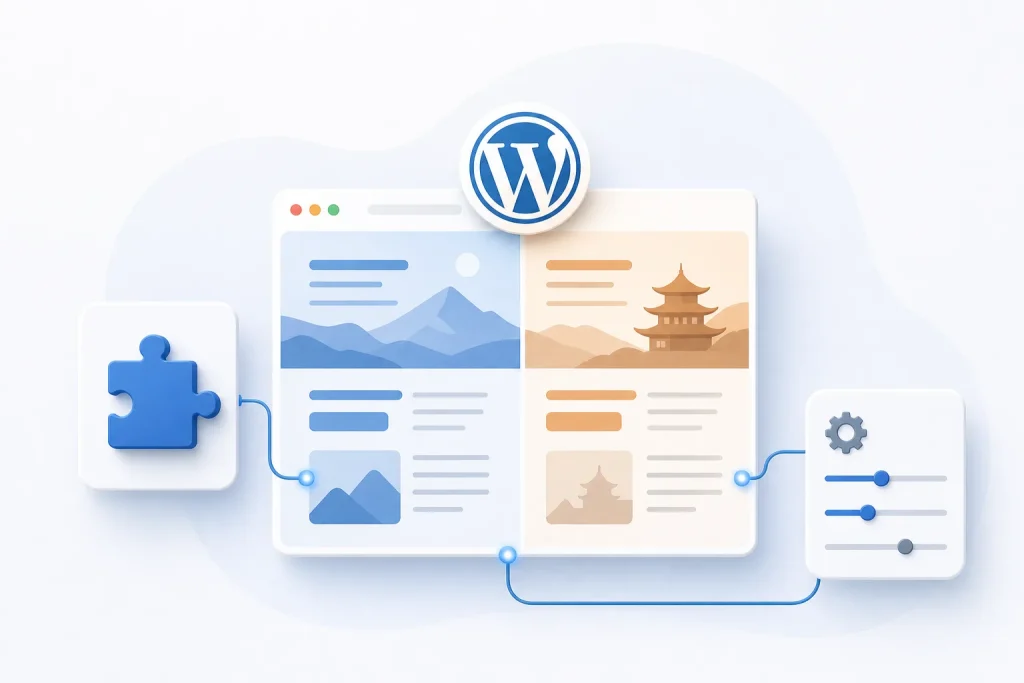
A multilingual WordPress setup usually has to solve two different problems at once. First, it must represent that a page exists in more than one language. Second, it must expose search-engine-facing metadata for each version of that page. Those are related, but they are not the same responsibility.
The multilingual layer is the place where language versions are connected to each other. The SEO plugin layer is the place where page-level signals such as titles, descriptions, canonicals, schema, XML sitemaps, and robots directives are emitted. If both layers try to own the same signal, the result is often duplication, mismatch, or a signal that points in the wrong direction.
Titles and descriptions need language-specific control, not shared defaults
Page titles and meta descriptions should usually be translated per language version, because they are part of the search snippet and should match the language of the content. The technical issue is not translation itself, but ownership: if the multilingual system stores the translated content while the SEO plugin stores the snippet fields, both systems need a predictable way to read and write the correct values.
A common failure mode is a translated page inheriting the source-language title or description because the SEO fields were copied once and never updated. Another failure mode is the opposite: the SEO plugin generates a fallback title from the translated content while the multilingual layer still treats the page as linked to a different language version. In both cases, the page may be technically reachable but semantically inconsistent for search and users.
Canonicals should reflect the preferred URL for each language version
Canonical tags are where ownership conflicts become visible quickly. A multilingual site usually needs each language version to be indexable on its own URL, while still signaling its relationship to the other versions. That means the canonical for a translated page should normally point to that page’s own preferred URL, not to the source-language page, unless the architecture intentionally consolidates them.
If an SEO plugin and a multilingual system both try to set canonicals, the risk is not just duplication in the HTML. The deeper problem is disagreement about which URL is the authoritative version for that language. Search engines may then receive mixed signals: one system says the translated page is canonical, another implies the source page should be preferred. The practical outcome can be indexing instability or the wrong page being surfaced for a query in a given language.
Schema should describe the page, while language relationships describe the site structure
Structured data and language relationships solve different problems. Schema describes the content and context of a page. Language relationships describe how equivalent or related pages across languages connect to one another. When these are conflated, the site can end up with schema that is technically valid but attached to the wrong language version, or with language links that do not match the page identity represented in structured data.
For implementers, the useful question is which layer generates the schema and which layer knows the language graph. If the multilingual system knows which pages are translations of each other, it should be the source of that relationship. If the SEO plugin generates schema from page content, it should do so per language version without assuming that translated pages are interchangeable copies.
XML sitemaps and robots directives should not duplicate indexing decisions
XML sitemaps and robots directives are both indexing controls, but they operate differently. Sitemaps tell search engines what exists and is intended for discovery. Robots directives tell them how to treat a page. In a multilingual setup, both need to align with the language architecture so that translated pages are discoverable when they should be, and excluded when they should not be.
The main engineering trade-off is whether the multilingual layer or the SEO plugin generates the sitemap entries for language variants. If both do, you can end up with duplicate URLs or inconsistent inclusion rules. If one system excludes a page while the other includes it, the site sends contradictory signals about whether that language version is meant to be indexed.
The safest pattern is a single owner for each SEO signal
The cleanest implementation is to assign one system as the owner of each signal and keep the other system aware of that decision. The multilingual layer should own language identity and relationships. The SEO plugin should own the presentation of metadata for each page version, but only within the boundaries set by the multilingual architecture.
This division reduces the chance that a translated page inherits the wrong metadata, emits a conflicting canonical, or appears in the wrong sitemap state. It also makes debugging easier: when a signal is wrong, you know which layer to inspect first instead of chasing two systems that both believe they are responsible for the same output.
| SEO signal | Preferred owner | Why |
|---|---|---|
| Titles | SEO layer, per language version | Needs page-level output that matches the translated content |
| Descriptions | SEO layer, per language version | Should reflect the language and intent of each version |
| Canonicals | Architecture-aware layer with SEO output | Must match the preferred URL for each language version |
| Schema | SEO layer, informed by language context | Describes the page and should be emitted per version |
| XML sitemaps | One system only | Duplicate sitemap ownership can create inconsistent inclusion |
| Robots directives | One system only | Conflicting directives can undermine indexing decisions |
| Language relationships | Multilingual architecture layer | Defines how translated pages connect to each other |
IMPORTANT
Frequently asked questions
Should every translated page have its own title and description?
Yes, if the page is meant to rank and be presented independently in that language. Reusing the source-language snippet fields can leave the page technically translated but still semantically mismatched in search results.
Can an SEO plugin manage multilingual canonicals by itself?
Only if the multilingual architecture already defines the correct language relationships and URL structure. Canonicals are not just a formatting choice; they depend on knowing which URL is the preferred version for each language.
Why do sitemap problems happen so often on multilingual sites?
Because sitemap generation is easy to duplicate. If both the multilingual layer and the SEO layer try to list language variants, they can disagree about which URLs belong in the indexable set.
What is the main rule for avoiding conflicts?
Give each signal one owner. Language relationships belong to the multilingual architecture, while page-level SEO output belongs to the SEO layer, with clear boundaries between them.
SOURCES & EVIDENCE
Google: Localized versions · Google: Canonicalization · WordPress wp_get_canonical_url()
PUT THE ARCHITECTURE TO WORK
See how WordPress integrations behave in a multilingual system
Explore plugin-specific compatibility, translation surfaces and implementation notes in the REEID Integration Directory.

AIOSEO
REEID has tested and verified AIOSEO compatibility with REEID Translate. No specific visitor-facing translation field is currently published for this integration.
Rank Math
REEID has tested and verified Rank Math compatibility with REEID Translate. No specific visitor-facing translation field is currently published for this integration.

Yoast SEO
REEID has tested and verified Yoast SEO compatibility with REEID Translate. No specific visitor-facing translation field is currently published for this integration.