REEID EDITORIAL
Multilingual WooCommerce: What Must Stay Synchronized Across Languages
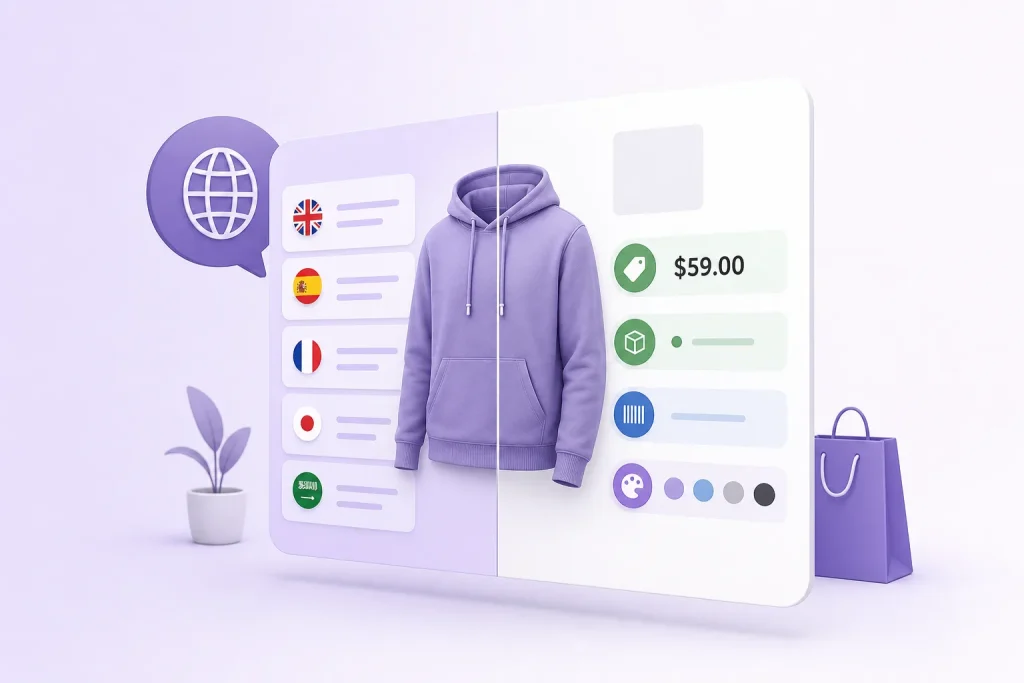
A multilingual WooCommerce store has two different kinds of product data: content that should be translated, and commerce data that should stay synchronized. If you blur that line, you can end up with mismatched prices, broken variation selection, inconsistent stock, or language versions that no longer point to the same purchasable product.
Key takeaway
Translate the customer-facing product narrative, but keep the underlying commerce model aligned across languages so every version resolves to the same product logic, inventory state, and checkout behavior.
The core model: translate content, synchronize commerce state
In a multilingual WooCommerce store, not every product field has the same job. Some fields exist to communicate with shoppers in a specific language, while others define the actual purchasable item and must remain consistent wherever that product appears.
That distinction matters because language versions are not just copies of text. They are usually separate representations of the same underlying product relationship. If the translated version diverges in stock, SKU, variation structure, or taxonomy mapping, the store can present a product that looks local but behaves like a different item at checkout.
| Data category | Typical treatment | Why |
|---|---|---|
| Product title, description, short description | Translate | These are customer-facing content fields. |
| Pricing | Synchronize | Different prices across languages create inconsistent purchasing behavior unless the business intentionally supports localized pricing. |
| Stock quantity and stock status | Synchronize | Inventory represents the same physical or sellable item across language versions. |
| SKU | Synchronize | SKU is an identifier for the product or variation and should not drift between translations. |
| Taxonomy relationships | Synchronize or map carefully | Categories, tags, and attribute terms affect browsing, filtering, and product grouping across languages. |
| Variations | Synchronize structure and identifiers | Variation sets must remain equivalent so each language version offers the same purchasable options. |
| Checkout behavior | Synchronize | Cart, checkout, and order logic must resolve the same product rules regardless of language. |
| Permalinks and routing | Language-aware but consistent | Each language needs its own URL path or routing pattern, but the product relationship should still resolve cleanly. |
| Canonical and language relationships | Synchronize at the relationship level | Search engines and internal navigation need a stable mapping between language versions. |
Translatable product content is the layer shoppers read
The most obvious multilingual fields are the ones that describe the product in natural language: title, long description, short description, and any other customer-facing copy attached to the product page.
These fields can differ by language without changing the underlying product identity. That is the point of translation: the shopper should understand the same offer in their own language, but the store should still be selling the same product record or linked product family.
Commerce data must stay synchronized because it drives purchase logic
Pricing, stock, SKU, and variation structure are not just display fields. They determine whether the product can be purchased, how it is identified in orders, and which options are available at add-to-cart time.
If one language version shows a different stock status or variation set, the storefront can become internally inconsistent. A shopper may land on a translated page that appears available, only to fail at checkout because the underlying purchasable state belongs to a different version. The reverse can also happen: a product may be out of stock in one language view but still appear available in another if synchronization is broken.
IMPORTANT
Taxonomies and attributes need deliberate mapping, not casual duplication
Categories, tags, and product attributes sit between content and commerce. They help shoppers browse, filter, and compare products, but they also influence how products are grouped and how variations are defined.
In multilingual setups, these relationships need careful handling. A translated category label is not the same thing as a different category relationship. If the mapping is wrong, the product can disappear from expected archive pages, filters can stop matching, or translated pages can point to taxonomy terms that do not correspond across languages.
Variations are the most fragile part of the multilingual product model
Variable products depend on a consistent structure: the same variation set, the same attribute logic, and the same relationship between parent product and child variations.
That structure has to survive translation. The visible labels for attributes can change by language, but the variation model itself cannot fragment. If one language version has a different set of variations, shoppers may see options that do not exist elsewhere, or the translated product may fail to resolve the correct purchasable variation when added to cart.
Checkout behavior must remain language-neutral at the logic layer
Checkout is where multilingual presentation ends and commerce logic takes over. The cart and checkout flow must resolve the same product identity, pricing rules, stock checks, and variation selections regardless of the language used to reach them.
This is why checkout behavior belongs in the synchronized layer. The shopper can read the interface in one language and complete the purchase in another, but the underlying order data still needs to point back to the same product and variation records. If that mapping breaks, order items can become ambiguous or inconsistent across language contexts.
Permalinks, routing, and canonical signals support language separation without product drift
Each language version needs its own route so search engines and users can reach the correct localized page. But separate URLs do not mean separate products.
The routing layer should distinguish language versions while preserving the relationship between them. That relationship is what keeps internal linking, canonical signals, and language-aware navigation aligned. If the URLs are isolated but the product linkage is weak, search engines may treat pages as unrelated duplicates or shoppers may land on the wrong language version from internal links.
Operationally, the question is which fields are source-of-truth fields
A useful implementation decision is to classify each product field by ownership. Translation-owned fields can vary per language. Commerce-owned fields should have one source of truth and be propagated to every language version.
That classification reduces ambiguity during updates. For example, if stock changes after a sale, the update should flow to every language version. If a marketer rewrites the product description, that change should stay within the translated content layer. The store becomes easier to maintain when editors know which fields are localizable and which are synchronized by design.
Frequently asked questions
Should product descriptions and prices be handled the same way in multilingual WooCommerce?
No. Descriptions are translatable content, while prices are commerce data that should stay synchronized unless the business intentionally supports localized pricing rules.
Why is SKU synchronization so important across languages?
SKU identifies the product or variation in a way that should remain stable across every language version. If it changes between translations, order handling and product maintenance become harder to trust.
Can translated categories be treated as separate taxonomies?
They should be mapped carefully rather than duplicated casually. The translated label can differ, but the relationship between product and taxonomy needs to stay coherent across languages.
What usually breaks first when multilingual product data drifts?
Variations and stock behavior often fail first because they depend on exact product structure and synchronized purchasable state. Those failures can surface as add-to-cart issues or inconsistent availability between languages.
SOURCES & EVIDENCE
PUT THE ARCHITECTURE TO WORK
See how WordPress integrations behave in a multilingual system
Explore plugin-specific compatibility, translation surfaces and implementation notes in the REEID Integration Directory.

WooCommerce
REEID has verified WooCommerce compatibility with 3 visitor-facing translation surfaces currently published for this integration.