REEID EDITORIAL
How to choose a multilingual WordPress architecture
Before you pick a plugin or translation workflow, decide how languages will live in your WordPress site: in URLs, in content ownership, in metadata, and in operational processes. Those architectural choices determine how pages are routed, how translations stay linked, what gets synchronized, and how search engines interpret the site.
Key takeaway
A multilingual WordPress architecture should be chosen by first defining URL structure, content ownership, translation relationships, metadata handling, and SEO signals; implementation details only work well when they fit those decisions.
Start with the architectural question, not the plugin
A multilingual WordPress site can be built in more than one structural way, and the choice affects everything downstream. If language is represented in the URL, in separate content objects, or in a shared content model with language relationships, each approach changes how WordPress resolves requests, stores content, and exposes canonical signals.
That means the first decision is not which tool to install. It is which parts of the site are language-specific, which parts are shared, and how WordPress should distinguish one language version from another without creating routing ambiguity or content drift.
Choose a language URL strategy that matches routing and indexing goals
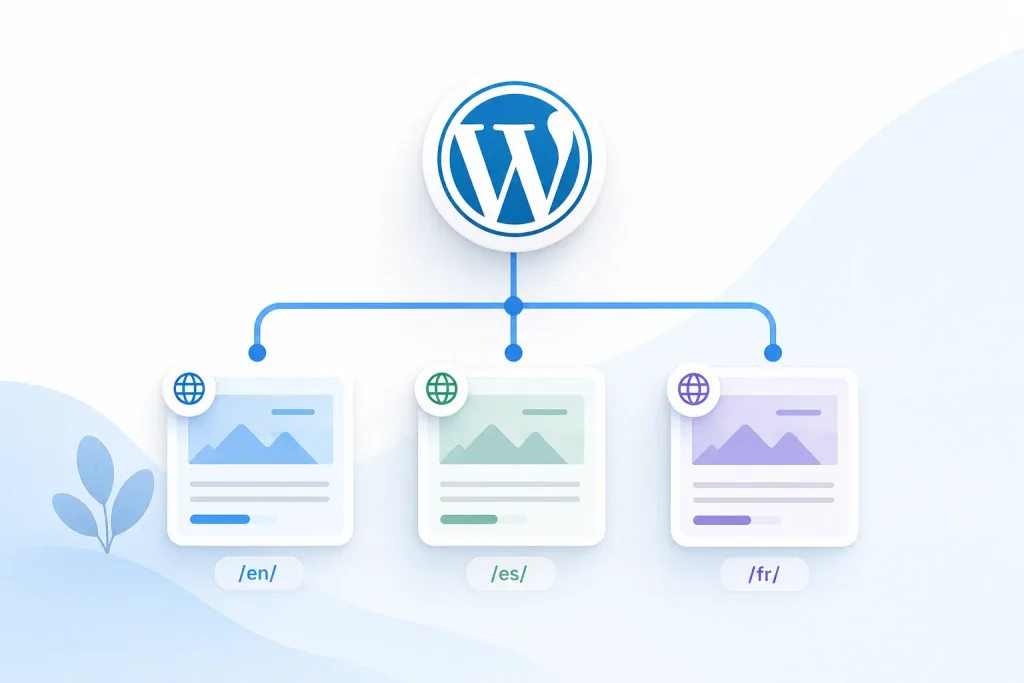
Language URLs are the visible contract between your site, users, and search engines. A multilingual WordPress architecture needs a consistent way to express language in permalinks so that each version can be routed correctly and indexed as a distinct page when appropriate.
The main architectural consequence is that URL strategy affects canonical signals, internal linking, and how easily language versions can be discovered and maintained. If the URL structure is inconsistent, translation relationships become harder to reason about and operational mistakes are more likely to surface as duplicate or mismatched pages.
The URL strategy should also align with how your site handles templates and dynamic rendering. If language is embedded in the path or domain, routing logic must reliably load the correct content object, metadata, and template context for that language before the page is rendered.
Define content ownership before you define translation workflow
A multilingual site needs a clear answer to a basic question: which content object is the source of truth for each language version? In WordPress terms, that means deciding whether a post, page, custom post type entry, or plugin-owned record owns the translation set and how the related versions are linked.
This matters because ownership determines who can edit what, which fields are synchronized, and how changes propagate. If ownership is unclear, teams can accidentally overwrite language-specific copy, detach translations from their source, or create inconsistent revisions across languages.
Ownership also affects operational workflow. Editorial teams need to know whether they are updating one shared record with language variants or maintaining separate records that are related by translation metadata. Those models have different failure modes when content is revised, unpublished, or duplicated.
Treat translation relationships as first-class data
Translation is not just text replacement. In WordPress, multilingual architecture usually depends on explicit relationships between content items so the system can map one language version to another. Those relationships may need to cover posts, pages, taxonomies, custom fields, and plugin-owned data.
If translation links are incomplete, the site can still render pages, but the operational model breaks down: language switchers may point to missing content, related content blocks may surface the wrong language, and updates may not propagate to the intended counterpart. The architecture should therefore define which objects are linked, which are independent, and which are derived from another language version.
This is especially important for content relationships such as parent-child page structures, category assignments, and language-specific landing pages. If those relationships are not modeled deliberately, the site can end up with correct text but incorrect navigation or broken contextual associations.
Decide which metadata is shared and which is language-specific
Metadata often determines whether a multilingual site behaves coherently or inconsistently. Titles, descriptions, custom fields, structured content, and plugin-owned metadata may need different synchronization rules depending on whether they affect presentation, SEO, or business logic.
A shared field can reduce duplication, but it can also create unintended coupling if one language needs a different value. A language-specific field gives editors flexibility, but it increases the number of values that must be maintained and validated. The architecture should define this boundary explicitly rather than assuming every field should behave the same way.
This decision also affects template rendering. If a template expects metadata to exist in every language, missing values can produce incomplete layouts or fallback behavior that is technically valid but editorially wrong.
Set synchronization rules before content starts moving
Synchronization is where multilingual systems either stay manageable or become noisy. Some fields should be copied across languages, some should be translated independently, and some should never sync after initial creation. The architecture needs rules for each category.
Without those rules, teams often discover that a change in one language unexpectedly overwrites another language’s custom fields, or that a shared structural update never reaches all versions. The failure mode is not just inconsistency; it is loss of editorial intent because the system cannot distinguish structural data from localized content.
A practical architecture separates synchronization into at least three buckets: always shared, initially copied then independent, and fully language-specific. That separation makes it easier to reason about revisions, reduce accidental overwrites, and preserve language autonomy where needed.
Account for plugin compatibility at the data-model level
Multilingual support is not only about posts and pages. Many WordPress sites rely on plugins that store their own data, generate dynamic output, or attach metadata to content objects. A multilingual architecture has to account for whether those plugins expose translatable fields, shared settings, or language-aware rendering.
Compatibility problems usually appear when a plugin assumes one global value but the site needs per-language variation, or when a plugin-owned record is linked to content in one language but not another. The result can be mismatched forms, inconsistent product data, or language switch behavior that does not preserve the user’s context.
For that reason, plugin compatibility should be evaluated as a data-model question: what data does the plugin own, how is it stored, and how does it relate to translated content? If those answers are unclear, the architecture may work for pages but fail for operational content that depends on plugin-owned records.
Design SEO signals as part of the architecture, not as an afterthought
Search engines need clear signals to understand which language version should rank and how alternate versions relate to each other. In a multilingual WordPress setup, those signals are shaped by URL structure, canonical behavior, internal linking, and the consistency of translation relationships.
If the architecture does not define these signals early, the site can produce ambiguous indexing behavior: multiple versions may compete, language pages may point to the wrong canonical target, or alternate versions may not be discoverable through the intended paths. The technical fix is not just adding tags later; it is ensuring the content model and routing logic already support the desired signal.
SEO decisions should therefore follow the content architecture. Once language URLs, ownership, and relationships are stable, the site can emit consistent signals that reflect the actual structure rather than trying to compensate for it.
Build operational workflows around editorial reality
A multilingual architecture succeeds or fails in day-to-day operations. Editors need to know how new language versions are created, how translations are reviewed, how updates are synchronized, and what happens when a source page changes after publication.
The workflow should reflect the ownership model. If translations are linked records, the process must preserve those links during duplication, revision, and publishing. If some fields are shared and others are localized, editors need a predictable way to see which values are inherited and which are editable per language.
Operationally, the most common failure mode is not technical downtime but content inconsistency: one language is updated while another remains stale, or a translation is published without the metadata needed for routing and indexing. A good workflow reduces those gaps by making the language relationship visible at each step.
| Decision area | What it controls | Typical failure mode if undefined |
|---|---|---|
| Language URL strategy | Routing, indexing, and visible language separation | Ambiguous URLs, weak canonical clarity, inconsistent discovery |
| Content ownership | Which record is the source of truth | Overwrites, detached translations, revision confusion |
| Translation relationships | How language versions are linked | Broken switchers, missing counterparts, wrong related content |
| Metadata rules | Which fields are shared or localized | Incomplete layouts, unintended coupling, stale values |
| Synchronization rules | How changes propagate across languages | Accidental overwrites, drift, lost editorial intent |
| Plugin compatibility | How plugin-owned data behaves per language | Mismatched dynamic output, context loss, unsupported fields |
| SEO signals | How search engines interpret alternates | Competing versions, incorrect canonicals, poor language targeting |
| Operational workflows | How editors create and maintain translations | Stale pages, inconsistent publishing, broken relationships |
Use a decision sequence that reduces rework
A practical way to choose a multilingual WordPress architecture is to decide in order: first the URL model, then content ownership, then translation relationships, then metadata and synchronization rules, and finally plugin compatibility and workflow.
That sequence matters because later decisions depend on earlier ones. For example, you cannot reliably define synchronization rules until you know which fields are shared, and you cannot define SEO behavior until you know how language versions are routed and linked.
If you reverse that order, implementation details tend to drive architecture instead of the other way around. The result is usually a site that works for the first language but becomes harder to extend, maintain, or audit as more languages are added.
Frequently asked questions
What should I decide first when planning a multilingual WordPress site?
Start with the language URL strategy and content ownership model. Those two decisions determine how WordPress routes requests, how translations are linked, and how later choices about metadata and synchronization should behave.
Why do translation relationships need to be explicit?
Because multilingual content is more than copied text. Explicit relationships let the site map language versions, preserve navigation and related content, and keep language switchers and updates aligned with the correct counterpart.
Which metadata should be shared across languages?
Only metadata that should remain structurally identical across versions. Fields that affect presentation, SEO, or localized business logic often need language-specific values, while purely structural fields may be shared or copied according to your synchronization rules.
What usually breaks first in a multilingual WordPress setup?
The most common failures are inconsistent routing, missing translation links, and unclear synchronization rules. Those issues show up as wrong language pages, stale metadata, or content that updates in one language but not another.
SOURCES & EVIDENCE
Google: Localized versions · WordPress Metadata API · WordPress Rewrite API
PUT THE ARCHITECTURE TO WORK
See how WordPress integrations behave in a multilingual system
Explore plugin-specific compatibility, translation surfaces and implementation notes in the REEID Integration Directory.

Elementor Website Builder
REEID has verified Elementor Website Builder compatibility with 3 visitor-facing translation surfaces currently published for this integration.

WooCommerce
REEID has verified WooCommerce compatibility with 3 visitor-facing translation surfaces currently published for this integration.
Yoast SEO
REEID has tested and verified Yoast SEO compatibility with REEID Translate. No specific visitor-facing translation field is currently published for this integration.