REEID EDITORIAL
Why Multilingual WordPress Is an Engineering Problem, Not a Translation Task
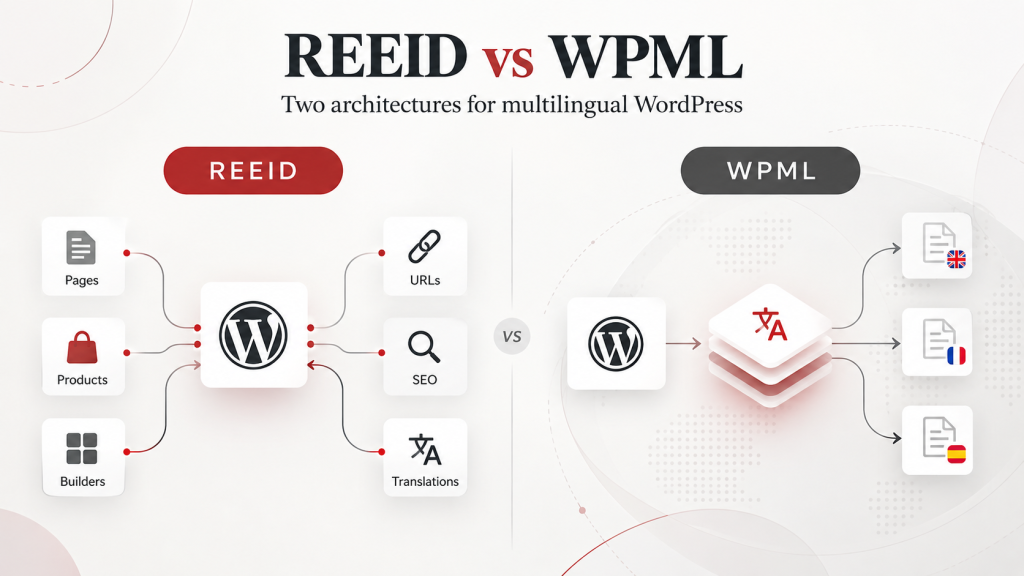
A multilingual WordPress website is not simply an existing website with its visible text replaced in another language.
Key takeaway
What visitors see on the page is only one part of the system. Behind it are blocks, builder data, custom fields, metadata, URLs, taxonomies, language relationships, SEO signals, cached output and content dependencies created by plugins and themes.
What visitors see on the page is only one part of the system. Behind it are blocks, builder data, custom fields, metadata, URLs, taxonomies, language relationships, SEO signals, cached output and content dependencies created by plugins and themes.
Translation is one operation inside that system.
The real challenge is discovering all relevant content, preserving its structure, connecting each language version correctly and keeping everything maintainable after the website changes.
That is why reliable multilingual WordPress requires engineering—not only translation.
A WordPress page is more than visible text
A simple page may appear to contain a heading, several paragraphs, an image and a button.
Internally, however, the same page may also contain:
- Gutenberg block attributes
- Page-builder configuration
- Button URLs and labels
- Image captions and alternative text
- SEO titles and descriptions
- Custom fields
- Reusable patterns
- Taxonomy relationships
- Shortcodes
- Plugin-generated data
- Structured content stored outside the main post body
Some of this information is visible to visitors. Some affects search engines. Some controls the page layout. Some may only appear under specific conditions.
A translation system therefore cannot safely assume that all translatable content exists in one WordPress editor field.
It must understand where content is stored, which parts should be translated and which parts must remain unchanged.
1. Content discovery comes before translation
Before translating anything, the system must answer a more difficult question:
What exactly belongs to this page?
The visible post content is an obvious starting point, but it is rarely the complete answer.
A page may depend on:
- Post titles and excerpts
- Gutenberg blocks
- Custom post meta
- Advanced Custom Fields
- Theme settings
- Widget content
- Navigation labels
- Forms
- Product attributes
- SEO plugin fields
- Reusable templates
- Global blocks
- Plugin-specific database tables
Missing any of these can produce an incomplete language version.
Translating the wrong data can be equally damaging. Internal identifiers, CSS classes, URLs, configuration values and serialized structures may resemble text while serving a technical purpose.
Reliable content discovery therefore requires rules for separating:
- Human-readable content
- Structural data
- Internal configuration
- References to other WordPress objects
- Values that require special processing
The quality of the final translation depends heavily on this discovery stage. A perfect translation model cannot translate content it never receives.
2. Builder structures must survive the process
Modern WordPress pages are structured documents.
Gutenberg stores content as a hierarchy of blocks. Page builders often store layouts as nested data containing sections, columns, widgets, style settings and references to reusable elements.
The text cannot always be extracted, translated and inserted back without understanding that structure.
Consider a button block. It may include:
- Visible button text
- Destination URL
- CSS classes
- Alignment settings
- Link behaviour
- Tracking attributes
- Design settings
Only part of that data should normally be translated.
The same applies to headings, accordions, tabs, testimonials, pricing tables, product grids and reusable templates.
A multilingual workflow must preserve the structure while changing only the intended content.
Otherwise, translation may cause:
- Broken block markup
- Missing builder elements
- Lost styling
- Incorrect links
- Invalid serialized data
- Content appearing in the wrong component
- Pages that can no longer be edited normally
This is not a linguistic problem. It is a data-transformation problem.
3. Metadata and custom fields are part of the page
Important website content often exists outside the main editor.
A custom field may contain:
- A subtitle
- A call-to-action label
- A product specification
- A location name
- A downloadable file description
- A frequently asked question
- A structured content section
SEO plugins also store titles, descriptions, social-media text and indexing instructions separately from the visible page content.
If these fields are ignored, the translated page may look complete while remaining incomplete for users, social networks or search engines.
However, custom fields cannot all be treated identically.
One field may contain translatable text. Another may contain a numerical value, an object ID, a URL or a technical setting. A third may reference another piece of content that requires its own translated counterpart.
A robust system needs field-specific behaviour:
- Translate
- Copy unchanged
- Map to a translated object
- Exclude
- Process using a custom rule
This is especially important on websites with custom themes, WooCommerce extensions, membership systems, directories or other structured content.
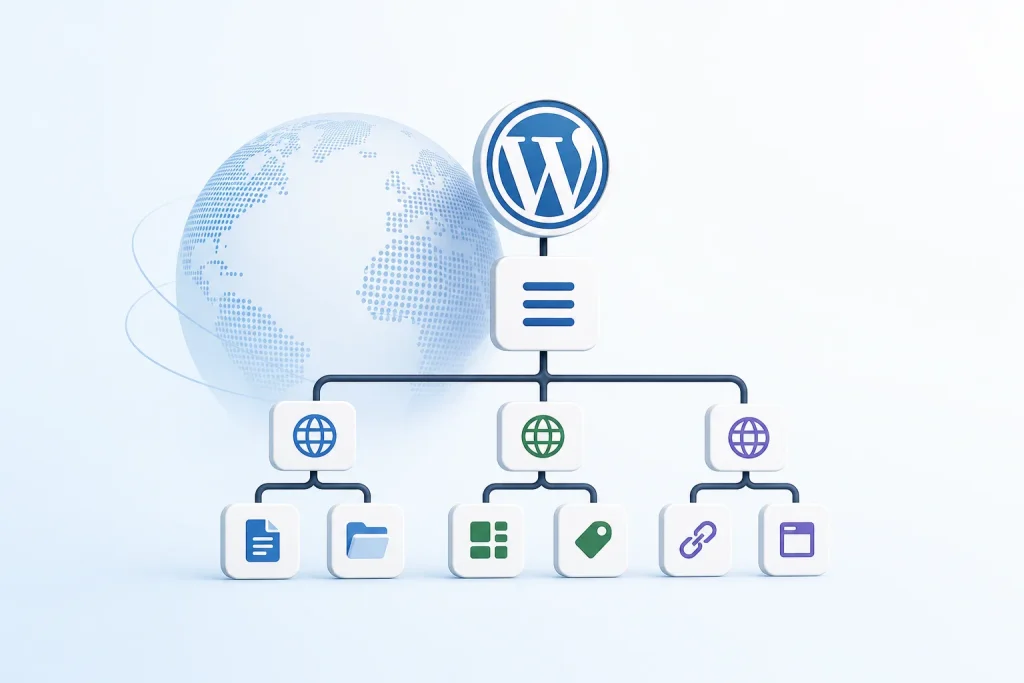
4. Every language version needs a URL architecture
A multilingual website needs more than translated pages. It needs a predictable way to locate and identify them.
Common structures include:
example.com/fr/page/fr.example.com/page/example.fr/page/
Whichever structure is selected must be applied consistently across:
- Pages
- Posts
- Products
- Categories
- Tags
- Archives
- Pagination
- Search results
- Sitemaps
- Canonical URLs
Translated slugs introduce another layer.
Should /services/ become /fr/services/ or /fr/services-professionnels/?
What happens when the source slug changes?
How should redirects be handled?
What happens when two translated titles produce the same slug?
These decisions affect users, internal links, analytics, search engines and future website maintenance.
URL architecture is therefore a fundamental part of the multilingual system—not a cosmetic setting applied after translation.
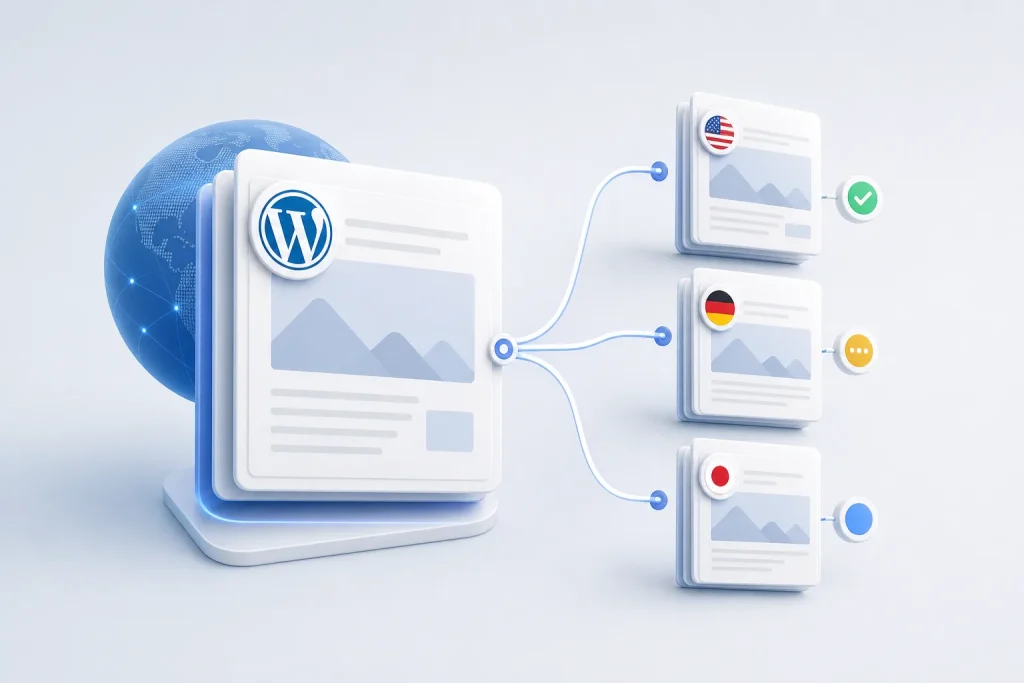
5. Language versions must remain connected
A translated page is not merely a duplicate page containing different text.
The system must know that:
- Page A in English
- Page B in German
- Page C in Thai
are language versions of the same underlying content.
These relationships support:
- Language switchers
- Alternate-language metadata
- Correct internal links
- Content synchronization
- Administrative navigation
- Translation status
- Update detection
- Search-engine language signals
The relationship must also survive normal WordPress operations.
Pages may be duplicated, deleted, restored, moved to draft, scheduled or replaced. Products may have variations. Taxonomy terms may be renamed. Content may be imported or updated through an API.
If language relationships are weak or stored inconsistently, the multilingual structure gradually deteriorates.
Visitors may be sent to the wrong page. Search engines may receive conflicting signals. Editors may unknowingly update one version while leaving the others disconnected.
Language relationships are therefore part of the website’s data model.
6. Multilingual SEO requires coordinated signals
Publishing translated text does not automatically create a correctly optimized multilingual website.
Each language version may require its own:
- SEO title
- Meta description
- Slug
- Canonical URL
- Open Graph text
- Structured data
- Internal links
- Sitemap entry
Search engines must also understand how the language versions relate to one another.
This commonly involves alternate-language references such as hreflang, but those references only work properly when the underlying URLs and language relationships are accurate.
A single incorrect URL can create a chain of problems:
- Broken alternate-language references
- Conflicting canonicals
- Missing pages in sitemaps
- Search engines selecting the wrong language version
- Regional pages competing with each other
- Translated pages remaining unindexed
Multilingual SEO therefore depends on coordination between translation, URL generation, metadata, sitemaps and page relationships.
It cannot be treated as a checkbox added at the end of the project.
7. Caching changes the behaviour of translation systems
Translation can involve expensive operations:
- Reading and parsing content
- Discovering strings
- Calling an AI model or translation provider
- Rebuilding structured content
- Writing translated records
- Regenerating SEO metadata
Repeating every operation on every request would be slow and wasteful.
Caching can reduce processing time and translation cost, but it introduces its own engineering questions:
- What should be cached?
- How is a source string identified?
- When does a cached translation expire?
- What happens when the original text changes?
- Can translations be reused across pages?
- Should identical strings share one translation?
- How are manual corrections preserved?
- How is stale content invalidated?
A translation cache must do more than store text.
It may need to account for:
- Source language
- Target language
- Translation provider
- Model
- context
- terminology
- site
- content type
- version
- manual edits
Poor cache design can return outdated or contextually incorrect translations. No caching at all can create unnecessary cost and processing delays.
The correct balance depends on how the website is built and how frequently its content changes.
8. Synchronization is an ongoing process
The first translation is only the beginning.
After launch, the source website continues to change:
- A heading is rewritten
- A product price table is updated
- A section is removed
- A button URL changes
- An image is replaced
- A custom field is added
- SEO metadata is revised
- A builder template is redesigned
The multilingual system then needs to determine:
- What changed?
- Which language versions are affected?
- Which content should be translated again?
- Which manually edited translations must be preserved?
- Should structural changes be copied automatically?
- Should old translated content be removed?
- Does the update require human review?
Simply retranslating the entire page is rarely the best solution.
It can waste resources and overwrite approved translations. Ignoring changes creates outdated language versions.
Reliable synchronization requires change detection, state tracking and clear rules for resolving conflicts between source updates and translated content.
9. Maintenance determines whether the system remains reliable
A multilingual website must continue working as WordPress evolves.
Themes and plugins are updated. Builders change their data structures. New content types are introduced. SEO plugins add fields. WordPress changes block behaviour. Translation providers update their APIs and models.
The multilingual layer must adapt without damaging existing content.
Ongoing maintenance includes:
- Compatibility testing
- Database migration
- Error handling
- Recovery after interrupted jobs
- Queue management
- Logging
- monitoring
- access control
- API limit handling
- validation of generated content
Large websites also require controlled processing.
Translating thousands of posts in a single browser request is not realistic. Work may need to be divided into queues and batches, with support for retries, resumable jobs and partial failure.
The system should be able to answer practical questions:
- Which pages were processed?
- Which items failed?
- Why did they fail?
- Which translations are outdated?
- Which language versions are missing?
- Can processing resume safely?
Without this operational layer, multilingual automation becomes difficult to trust.
Translation quality still matters—but it is not enough
None of this makes linguistic quality unimportant.
The translated language must still be accurate, natural and appropriate for its audience. Terminology, tone, context and review remain essential.
The distinction is that linguistic quality alone cannot create a functional multilingual WordPress website.
A well-written translation can still be placed in the wrong field.
It can exist on a page with a broken layout.
It can be disconnected from its source.
It can use an incorrect canonical URL.
It can disappear when a builder template is updated.
It can remain invisible to search engines.
Successful multilingual publishing requires both language quality and technical integrity.
The role of AI
AI has made high-quality translation faster and more accessible.
It can assist with:
- Translation
- Rewriting
- Terminology
- Context adaptation
- Metadata generation
- Summarization
- Quality review
But AI does not remove the need for a multilingual architecture.
The model still needs to receive the correct content. Its output must be returned to the correct location. WordPress structures must remain valid. URLs and language relationships must be created. Updates must be detected. Approved content must be protected.
Sending a paragraph to an AI model is easy.
Operating a reliable multilingual WordPress system around that model is the difficult part.
How REEID approaches multilingual WordPress
REEID approaches multilingual WordPress as a technical content-processing system.
The work involves more than replacing text. It includes understanding how WordPress stores content, how builders structure pages, how plugins introduce additional fields and how language versions must remain connected over time.
This approach brings together:
- Content discovery
- Structured extraction
- WordPress-native processing
- AI-assisted translation
- Metadata handling
- Language relationships
- Multilingual SEO
- Translation reuse
- Synchronization
- Compatibility work
- Ongoing maintenance
The objective is not simply to create translated text.
It is to produce multilingual WordPress content that remains editable, connected, discoverable and maintainable.
Conclusion
A multilingual WordPress website is a network of related content, structures, URLs and technical signals.
Translation is a critical part of that network, but it is only one part.
The complete problem includes discovering content, preserving builder structures, processing metadata, managing URLs, connecting language versions, supporting SEO, caching results, synchronizing changes and maintaining compatibility over time.
Treating multilingual WordPress as a translation task may work for a small static page.
Treating it as an engineering system is what allows it to work reliably at scale.
SOURCES & EVIDENCE
Google: Localized versions · WordPress Metadata API · WordPress Rewrite API