REEID EDITORIAL
Scaling multilingual WordPress to thousands of pages
When a multilingual WordPress site grows into the thousands of pages, the hard problems stop being translation alone. The real work shifts to managing translation state, keeping source and target content synchronized, handling retries without duplicating work, preserving URL and canonical consistency, and making sure search engines can crawl the right language versions efficiently.
Key takeaway
At scale, multilingual WordPress is an operational system: every page needs tracked translation state, controlled synchronization, predictable URL behavior, and quality checks that prevent stale or inconsistent language variants from accumulating.
What changes when multilingual WordPress reaches scale
A small multilingual site can survive on manual review and occasional updates. At thousands of pages, that approach breaks because every source edit can fan out into multiple language variants, each with its own publication state, URL, and quality status.
The architectural shift is from managing pages to managing relationships between pages. A translated page is no longer just content; it is a linked record with dependencies on the source version, translation status, and any shared fields or templates that must stay aligned across languages.
This is where WordPress-specific structure matters. Blocks, templates, custom fields, post meta, and plugin-owned data can all carry language-sensitive content. If those elements are not tracked consistently, the site can end up with translated body copy that is current while structured data, metadata, or template-driven output remains stale.
Translation queues need state, not just tasks
At scale, translation work needs a durable state model. A queue that only says “pending” or “done” is not enough when pages can be edited again before translation finishes, or when a translation job fails halfway through.
Useful state tracking distinguishes at least the source version, the target language, the current job status, and whether the translated content is still aligned with the latest source revision. Without that, teams cannot tell whether a page is waiting for translation, waiting for review, or already stale because the source changed after the job started.
This matters operationally because the queue becomes a control plane for publishing. Editors need to know which pages can be safely released, which ones should remain unpublished, and which ones require retranslation after a source update.
Synchronization failures usually come from partial updates
Synchronization is not just copying text from one language to another. It also includes keeping shared fields, relationships, and template-driven output aligned across versions.
A common failure mode is partial synchronization: the translated post content updates, but related metadata does not. That can leave permalinks, canonical signals, language relationships, or custom fields pointing at mismatched content states. Another failure mode is over-synchronization, where a source update overwrites language-specific editorial decisions that should remain local to the target language.
The engineering trade-off is between strict coupling and editorial flexibility. Tighter synchronization reduces drift, but it can also erase legitimate language-specific differences. Looser synchronization preserves local control, but it increases the risk of stale or inconsistent data across the site.
Retries must be idempotent or they create duplicate work
Large multilingual sites inevitably need retries. Translation jobs fail, content updates collide, and external processes can time out. The problem is not retrying itself; it is retrying without a stable way to recognize what has already been processed.
If a retry cannot safely resume from the last known state, it may create duplicate translation records, duplicate language relationships, or repeated updates to the same target page. That can produce inconsistent publication states and make it difficult to know which version is authoritative.
A robust retry model needs a clear source of truth for job identity and completion state. In WordPress terms, that usually means the translation workflow must be able to reference the underlying post, its language relationship, and the version of the source content that the job was based on.
Stale content is a lifecycle problem, not just an editorial one
At scale, stale content appears when translation lag exceeds the rate of source change. A page can be technically translated but still be operationally outdated if the source has moved on.
This is especially visible when structured content changes. A translated landing page may still read correctly while its linked custom fields, dynamic blocks, or template output no longer match the source page’s current offer, taxonomy, or internal relationships. The result is not only editorial drift but also inconsistent user journeys across languages.
The practical consequence is that freshness has to be measured per language version, not just per source page. Teams need to know whether a translation is current relative to the source revision it was derived from, and whether any shared data has changed since then.
Crawl efficiency depends on predictable language URLs and canonical signals
Search engines can only crawl multilingual sites efficiently when each language version has a stable URL pattern and clear routing behavior. If language URLs are inconsistent, duplicated, or generated in ways that change over time, crawl paths become harder to predict and indexing quality suffers.
Canonical signals and language relationships help search engines understand which page version belongs to which language and which URL should be treated as the preferred representation for that language. At scale, these signals are not cosmetic; they are part of the site’s routing and indexing contract.
The operational risk is that translation workflows can accidentally produce URL drift. If a translated page is moved, regenerated, or re-linked without preserving its language relationship and canonical behavior, search engines may encounter duplicate or ambiguous variants instead of a clean multilingual structure.
Quality control has to be systematic because manual review does not scale
When a site reaches thousands of pages, quality control cannot rely on spot checks alone. Manual review is still useful, but it cannot reliably catch every stale field, broken relationship, untranslated fragment, or routing inconsistency across multiple languages.
A practical quality-control model checks for structural completeness as well as linguistic quality. That means verifying that translated pages exist where expected, that shared fields are synchronized correctly, that language relationships are intact, and that published URLs resolve consistently.
The main trade-off is coverage versus editorial effort. More automated checks reduce the chance of silent failures, but they also require a clear definition of what counts as complete and valid for each content type. That definition should reflect how the site actually uses blocks, templates, custom fields, and plugin-owned data.
Operational model for a large multilingual WordPress site
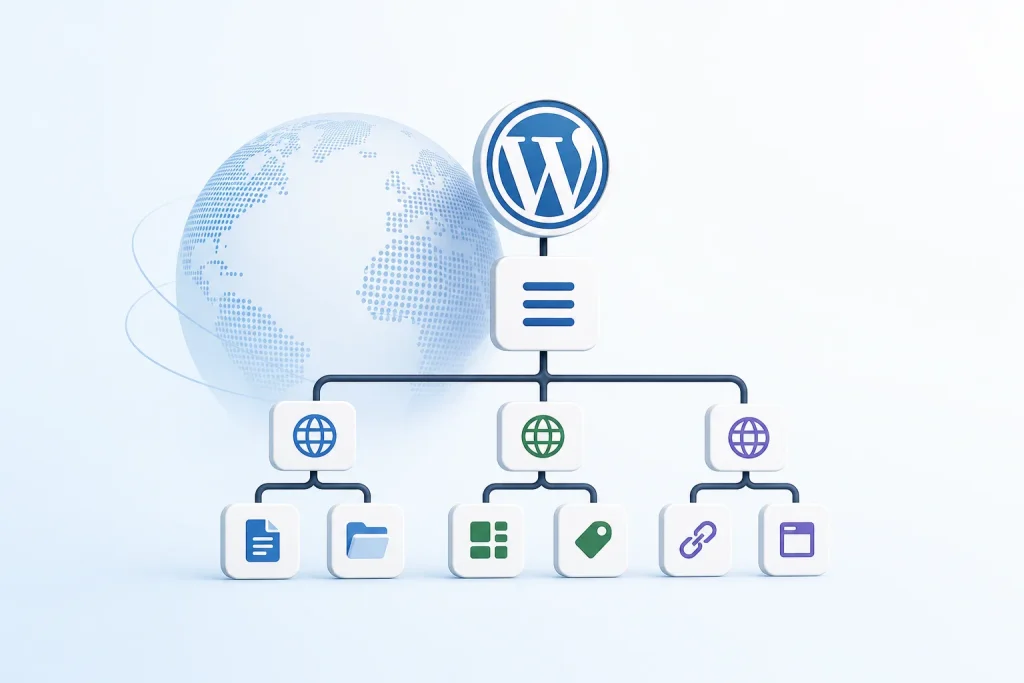
A scalable multilingual workflow usually needs three layers working together: content structure, workflow state, and publishing rules. Content structure defines what is translated and what is shared. Workflow state tracks where each language version is in the process. Publishing rules decide when a page can go live and what must be true before it does.
In WordPress terms, that often means treating the source post as the authoritative record for relationships and versioning, while language variants carry their own publication state and localized content. Shared data such as templates, routing behavior, and canonical signals must be managed so they remain consistent without eliminating legitimate language-specific differences.
The goal is not perfect automation. The goal is controlled automation: enough synchronization to prevent drift, enough state tracking to make failures visible, and enough editorial flexibility to preserve language quality.
Frequently asked questions
Why does multilingual WordPress become harder at thousands of pages instead of just more time-consuming?
Because the site stops being a collection of independent pages and becomes a network of linked language versions. Once translation state, synchronization, retries, and canonical behavior all have to stay aligned, small inconsistencies can cascade into stale content or crawl problems.
What is the biggest risk of weak translation state tracking?
You lose the ability to tell whether a translated page is current, pending, failed, or stale relative to the source revision. That makes publishing decisions unreliable and increases the chance that outdated language versions stay live.
Why are canonical signals and language relationships part of the scaling problem?
Because they help define how search engines interpret each language version and which URL belongs to which page variant. If those relationships drift, crawl efficiency and indexing consistency suffer.
What should quality control check beyond translated text?
It should also check shared fields, template output, content relationships, URL consistency, and whether each language version still matches the source revision it was derived from.
SOURCES & EVIDENCE
PUT THE ARCHITECTURE TO WORK
See how WordPress integrations behave in a multilingual system
Explore plugin-specific compatibility, translation surfaces and implementation notes in the REEID Integration Directory.

Elementor Website Builder
REEID has verified Elementor Website Builder compatibility with 3 visitor-facing translation surfaces currently published for this integration.

WooCommerce
REEID has verified WooCommerce compatibility with 3 visitor-facing translation surfaces currently published for this integration.

Yoast SEO
REEID has tested and verified Yoast SEO compatibility with REEID Translate. No specific visitor-facing translation field is currently published for this integration.